 Sanjog
Kundli matching for marriage: how guna milan works
For many Indian families, kundli milan is one of the first things checked once a rishta looks promising. Most of what people mean by it is guna milan, also called ashtakoota matching: a score out of 36 worked out from the bride's and groom's moon signs and nakshatras. Here is what that score is made of, how to read it, and how to see it for a match in the Sanjog app.
What guna milan measures
Guna milan compares the position of the moon at the time of birth for two people. From the date, exact time and place of birth, an astrologer (or software) works out each person's rashi (moon sign) and nakshatra (lunar mansion). Eight factors, the ashtakoota, are then compared and given points. Together they add up to a maximum of 36 gunas.
The eight kootas and their points
| Koota | Max points | Traditionally looks at |
|---|---|---|
| Varna | 1 | Temperament and outlook |
| Vashya | 2 | Mutual attraction and influence |
| Tara | 3 | Birth-star compatibility, wellbeing |
| Yoni | 4 | Physical compatibility |
| Graha Maitri | 5 | Friendship between the moon-sign lords, mental harmony |
| Gana | 6 | Nature: deva, manushya or rakshasa |
| Bhakoot | 7 | Relative position of the moon signs; family and finances |
| Nadi | 8 | Health and children |
| Total | 36 |
The higher kootas carry more weight. That is why families often look past the total at Nadi and Bhakoot: zero points in Nadi is called nadi dosha, and zero in Bhakoot is a bhakoot dosha. Many astrologers also check whether a dosha is cancelled by other factors before calling it a problem.
What is a good guna score?
The common rule of thumb is that 18 of 36 is the minimum for a match, and a higher score is better. Sanjog groups the total like this:
| Guna score | How Sanjog labels it |
|---|---|
| 31 to 36 | Excellent |
| 21 to 30 | Very good |
| 17 to 20 | Middling |
| Below 17 | Inauspicious |
A score is a starting point for a family conversation, not a verdict. Two people with 20 gunas who share values may suit each other better than two strangers with 30. Families who take kundli seriously usually also ask their own astrologer to look at manglik status and the full charts.
Check the guna score for a match on Sanjog
- Find the exact birth time. Take it from the birth certificate or hospital record. A few minutes can change the nakshatra, and with it the score.
- Add your birth details. In your profile open Kundli & birth details. Your date of birth is already filled in; add the time of birth and the place of birth. If you already have a kundli, you can upload it as a PDF or a photo.
- Open a profile you like. Scroll to the kundli section. If that member has shared their birth details too, you will see a Calculate button.
- Tap Calculate. Sanjog shows the total out of 36, the category, and the points for each of the eight kootas, from Varna to Nadi.
- Read it with your family. Look at the total, then at Nadi and Bhakoot, and talk it over before you decide.
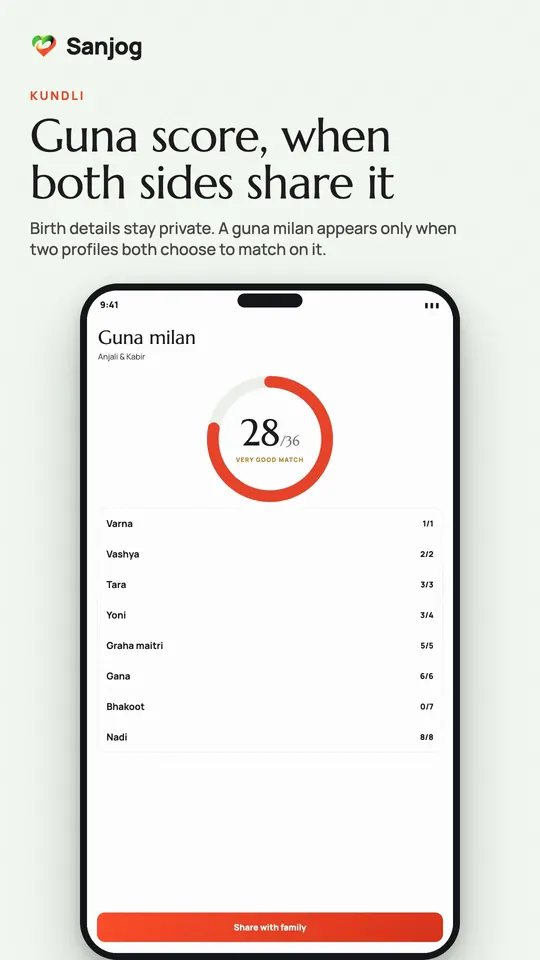
Your birth details stay private. Other members never see your birth time or place. They see only the guna score for the two of you, and only when both sides have shared birth details.
Common questions
Can I match kundli without the birth time?
Not reliably. The moon moves through a nakshatra in about a day, so without the time the nakshatra, and the score, can be wrong. If the time is unknown, many families rely on the rashi alone or skip kundli matching.
Is 18 gunas enough for marriage?
By the common rule, 18 is the minimum. In practice families also look at which kootas scored zero and whether any dosha is cancelled.
Do I have to add birth details to use Sanjog?
No. Kundli is optional. Tap Maybe later and add it whenever you like. Without it, no guna score is shown for your profile.